


The Data Story: Why Cybersecurity Is a Data Problem
Key takeaways
- Cybersecurity is a data problem, not a tool problem. Adding tools adds alerts; what protects an organization is the ability to understand the data it already has.
- The breach condition is a knowledge gap. It is the difference between what an attacker understands about your network and what you understand about it yourself.
- Context turns noise into a story. A login from London at 2:00 a.m. means nothing alone and everything once it is matched to the user, her calendar and her last login.
- Five steps turn raw data into protection: aggregation, correlation and analysis run at machine speed; decision making and execution belong to people.
- The capability has to be run, not bought. A Managed Cybersecurity Operations Provider (MCOP) or a Regional SOC runs the engine around the clock.
- The proof: the City of Aurora, Illinois detected over 35,000 threats, eliminated 351 high-severity threats and had zero major security incidents, for 77% less than an in-house SOC.
Part 1: Why Cybersecurity Is a Data Problem, Not a Tool Problem
Leaders of mission-critical organizations have, for the most part, done the responsible things. They have allocated the budget, bought the security tools and hired the people, and yet one question still lingers whenever a board or a council raises it: are we truly secure? It is a hard question to answer with confidence, and the reason has less to do with effort than with how security programs are built.
The tool trap
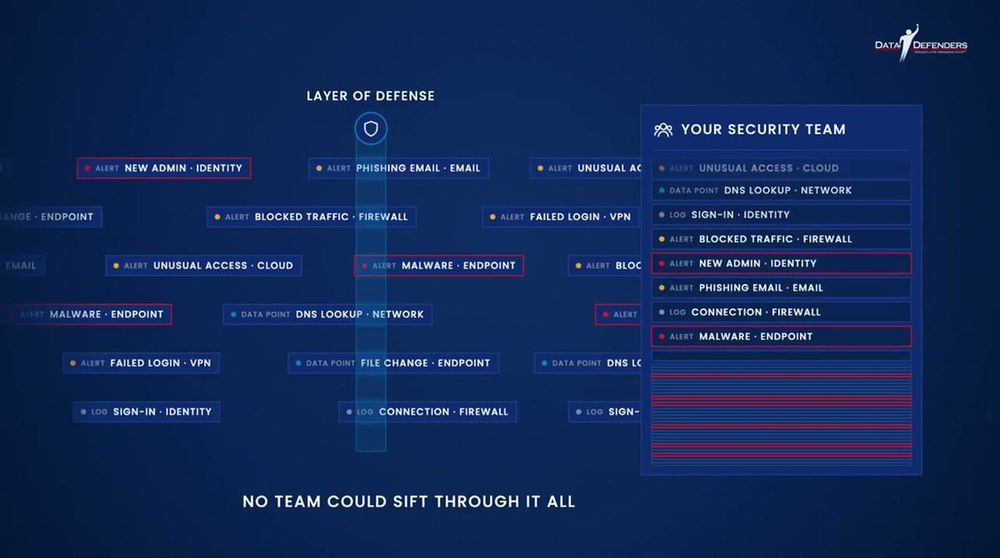
Cybersecurity programs tend to grow one purchase at a time. A new threat surfaces and a tool is bought to stop it, then another threat emerges and another tool is added. Over the years that reactive cycle produces point solution sprawl, a fragmented system in which every tool works in its own silo and none of them talk to each other.
The result is a tidal wave of data. Every tool generates its own alerts and its own logs, in a volume no team could sift through to find the threats that matter. The dashboard meant to show everything ends up blinking with alerts while telling you nothing, and the false sense of security it creates is more dangerous than an honest gap.
The information war
Data overload does more than confuse the security team, because it hands the attacker a strategic advantage. On one side, defenders are drowning in alerts, constantly reacting and missing the larger picture. On the other side, the attacker is calm and patient, studying the environment and quietly connecting the dots to find a way in.
The attacker has the upper hand not because of better technology but because of context. Attackers research your systems methodically, and over time they assemble the story of your organization from the same data your team sees only as separate pieces.
The breach condition
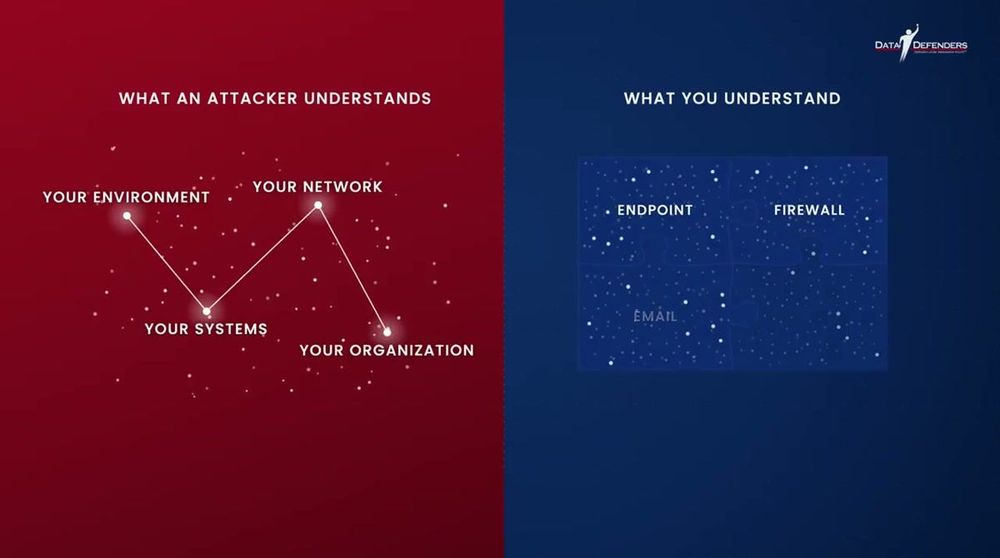
This leads to a more accurate way of thinking about risk. The real vulnerability, called the breach condition, is not a missing piece of software but a knowledge gap, the difference between what an attacker understands about your network and what you understand about it yourself.
As the episode notes, forensic analysis of nearly every major breach on record reveals the same pattern, in which the evidence was already sitting in the organization's own logs. The information existed, but the ability to interpret it did not.
That is why cybersecurity has to be treated as a data problem rather than a tool problem. For a city manager, a mayor, a hospital director or a business owner, the goal is not to buy more tools that generate more data, but to build the capability to understand the data the organization already has.
Context in action

Consider a single alert showing that someone has logged into the network from London at 2:00 in the morning. On its own, that data point is impossible to judge, and in most environments it would be dismissed as noise.
Now consider what happens when context is added. The user is Jane Doe, the CFO, whose normal location is headquarters in Chicago, whose calendar shows no international travel, and whose account was used to log in from Chicago an hour earlier. With those layers in place, the same alert tells a very clear story about a critical threat happening right now. The data point did not change, but the context around it did.
The five-step process
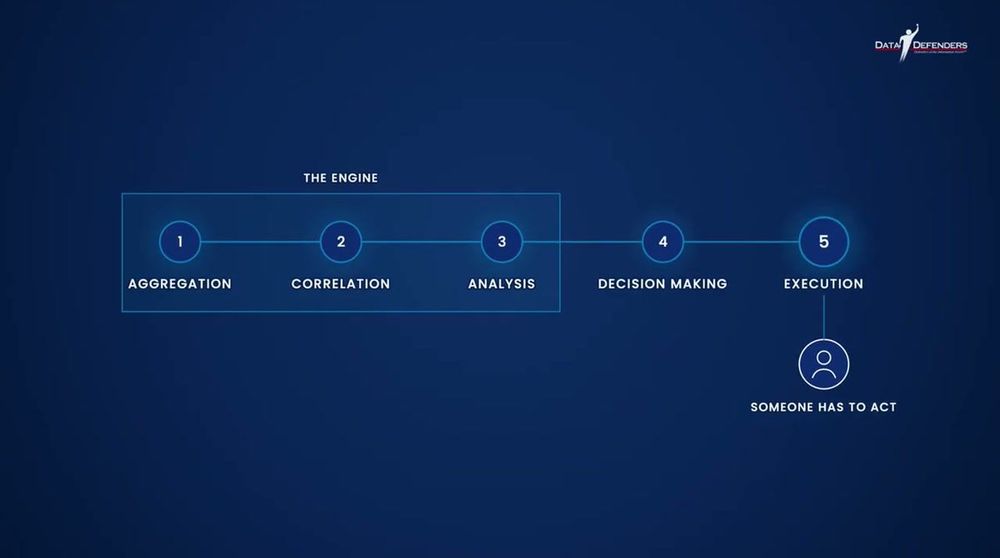
Turning noise into a story reliably takes a disciplined process with five steps.
- Aggregation. All data from every source, tool, device and endpoint is pulled into one repository, the data lake, where everything goes in and nothing is filtered out before it has been seen.
- Correlation. Data points are connected to each other, revealing relationships that could not be seen before, such as the London login matched against the Chicago login and the CFO's calendar.
- Analysis. The connected dots become a complete picture, a story a person can understand and act on.
- Decision making. Someone looks at that story and decides what it means, what the priority is and what needs to happen next.
- Execution. Someone acts on the decision by responding, containing and remediating.
The first three steps form an engine, a continuous process that takes in millions of raw data points, known as telemetry, and turns them into a coherent narrative. Finding the story is only half the job, though, because the last two steps belong to people, a point explored further in The Human Element in Cybersecurity Risk.
The question Part 2 answers
Every leader now faces the same question. The organization needs an engine that can see everything, connect the dots and tell the story as it unfolds, so how does that engine get built, and who should be running which part of it? Most organizations get that answer fundamentally wrong, and Part 2 of The Data Story takes it up.
Watch Part 1 on YouTube: https://youtu.be/sGbbsmrPw_g
Listen to Part 1 on Spotify: https://open.spotify.com/episode/0t6bJesyJxSkELJUCkzFFl
Part 2: The Engine That Finds the Story, and Who Should Run It
Part 1 ended on a question most organizations have never asked themselves. Security teams are overwhelmed by fragmented data while attackers calmly connect the dots, and the five steps that turn raw data into protection only work if each step is in the right hands, so who should actually be doing which steps? Part 2 answers that question, and the answer changes how a security operation functions.
The engine
If the core problem is that leaders are missing the story, the solution has to be an engine that finds the story for them. That engine is not another piece of software bought off the shelf, but the first three steps of the process running as a continuous cycle. Aggregation pulls everything from every source into one place, so there are no more silos. Correlation automatically finds the hidden connections, such as the London login from Part 1, and analysis assembles those connected dots into a complete story that a person can understand and act on.
Without that engine, data flows into a central monitoring dashboard, which security teams call a SIEM, and sits there as blinking alerts with no context behind them. The data has been trying to tell the story all along, and the engine is what finally lets an organization read it.
Who drives the engine
Having a powerful engine is one thing, but someone has to operate it, and for city managers, hospital directors and nonprofit leaders this is the real sticking point. The capability cannot simply be bought, because it has to be run around the clock, every day of the year.
The model that makes this possible is a Managed Cybersecurity Operations Provider (MCOP), an operational partner that runs the entire engine day in and day out and carries that operational weight so the organization's own team does not have to. The organization is not buying a tool it has to manage or hiring a team of data scientists, but engaging a service that delivers the one outcome it actually needs, which is the story.
The contrast with the old way is stark. Building this capability alone meant building a data lake, hiring expensive analysts and managing a never-ending flood of alerts, which made it affordable only at enterprise scale. State and local governments, community hospitals and regional nonprofits, the organizations that are the backbone of their communities, were left without it. The right operational model brings a capability once reserved for the Fortune 500 to organizations that cannot afford the Fortune 500 approach and should not have to. For municipalities, a Regional SOC lets several units of government share one operation.
Real-world proof: the City of Aurora, Illinois
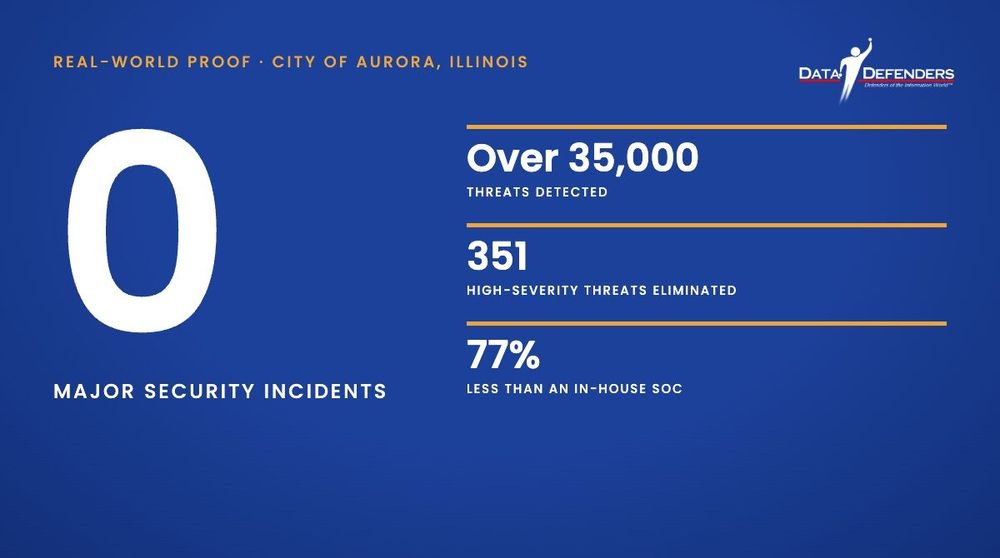
The results from the City of Aurora, Illinois show what this looks like in practice. The analytics engine detected over 35,000 potential threats, far more than any human team could sift through by hand. From that volume, 351 high-severity threats were pinpointed and eliminated before they could do damage, any of which could have become a headline-making breach.
The number that matters most to leaders, board members and residents is zero, because the city had zero major security incidents. It achieved that result for 77% less than it would have cost to build and staff a comparable security operations center of its own. The full story is in the City of Aurora case study.
The three pillars
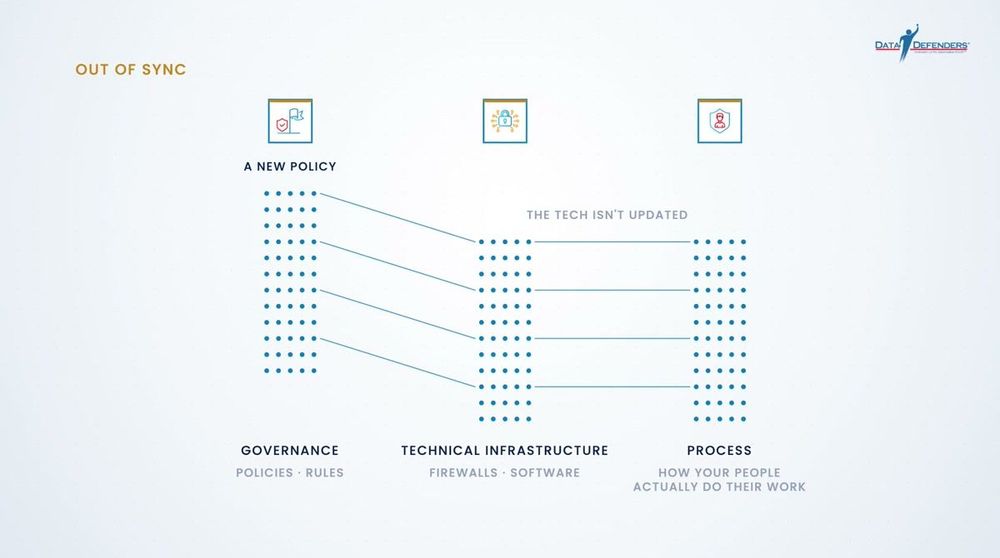
Every organization's security program rests on three pillars: governance, which covers policies and rules; technical infrastructure, which covers firewalls and software; and process, which covers how people actually do their work. All three generate data that affects the others, and when they fall out of step, a gap opens. A new policy that the technology is never updated to enforce is exactly that kind of gap, and the gap is the vulnerability.
An operational partner correlates data from all three pillars continuously to keep them in balance. It manages that drift, so that a small misalignment does not cascade into a major security failure.
Four new realities and a new goal
Taken together, the two parts of The Data Story describe four new realities for leaders. Cybersecurity is now a data problem, not a tool problem. The scale and speed of threats mean human-only management is no longer possible, which makes an AI-augmented partner a requirement rather than a nice-to-have, and this level of security is finally accessible to organizations of every size.
Those realities change the goal itself. For decades, security has been about trying to manage an endless stream of alerts, while the right goal is to own your data's story. When an operational partner owns that story for you, you are free to focus on your own story, which is your mission.
Watch Part 2 on YouTube: https://youtu.be/Rt4YamKDFVk
Listen to Part 2 on Spotify: https://open.spotify.com/episode/7zWLs3bZh1SyOZ8pD8rZG3
Frequently asked questions
What does it mean that cybersecurity is a data problem, not a tool problem?
It means the evidence of an attack is usually already in an organization's own logs, and what is missing is the ability to connect and interpret it. Buying more tools adds more alerts without adding understanding; building the capability to read the data you already have closes the gap.
What is the breach condition?
The breach condition is the knowledge gap between what an attacker understands about your network and what you understand about it yourself. It is the real vulnerability, rather than any single missing piece of software.
What are the five steps that turn security data into protection?
The five steps are aggregation, correlation, analysis, decision making and execution. The first three run continuously at machine speed on a data lake, and the last two are human: someone decides what the story means and someone acts on it.
What is a Managed Cybersecurity Operations Provider (MCOP)?
An MCOP is an operational partner that runs the security data engine around the clock for an organization, so its own team receives the story it needs rather than a flood of alerts. It is a category of service, not a product. Read how the MCOP model works.
Can a city, hospital or nonprofit afford this level of security?
Yes. The City of Aurora, Illinois achieved zero major security incidents for 77% less than building its own security operations center, and a Regional SOC lets smaller municipalities share one operation.
Related reading
- City of Aurora, Illinois: zero major incidents
- Why MCOP is the future of managed cybersecurity
- Regional SOC utilities: shared cyber defense for municipalities
- Cybersecurity best practices for municipalities
- How to close your network visibility gap
- Practical guides, assessment checklists and frameworks
Glossary
- Aggregation: the first of the five steps, pulling data from every source, tool, device and endpoint into one place.
- Analysis: the third step, assembling connected data points into a complete story a person can understand and act on.
- Breach condition: the knowledge gap between what an attacker understands about your network and what you understand about it yourself.
- Context: the surrounding facts, such as a user's role, location, calendar and recent activity, that turn a single data point into a meaningful signal.
- Correlation: the second step, connecting data points to reveal relationships that cannot be seen in isolation.
- Data lake: a single repository where all security data goes in and nothing is filtered out before it has been seen.
- Decision making and execution: the fourth and fifth steps, in which people decide what the story means and act on it by responding, containing and remediating.
- Managed Cybersecurity Operations Provider (MCOP): an operational partner that runs the security data engine around the clock and delivers the story, not just alerts.
- Point solution sprawl: a fragmented collection of security tools, bought one threat at a time, that work in silos and do not talk to each other.
- Regional SOC: a shared security operations center that lets several units of local government pool one operation.
- SIEM: security information and event management, the central dashboard where security data and alerts are collected.
- SOC: security operations center, the team and facility that monitors and responds to threats.
- Telemetry: the continuous stream of raw data points that systems, devices and tools generate about their activity.
About Data Defenders
Data Defenders is a Managed Cybersecurity Operations Provider (MCOP) built for mission-critical organizations that face enterprise-level threats without enterprise-level resources. Unlike traditional Managed Security Service Providers (MSSPs) that monitor and alert, Data Defenders operates as a continuous security operation, delivering 24/7/365 threat detection, proactive threat hunting, and coordinated incident response through our Cybersecurity Operations 2.0 framework. We serve SLTT governments, municipal healthcare systems, and 501(c)(3) nonprofit organizations through Co-Managed Security Operations and symmetrical partnerships that keep governance and strategic direction with the client while we provide continuous operational defense.
Protect and Secure What Matters®